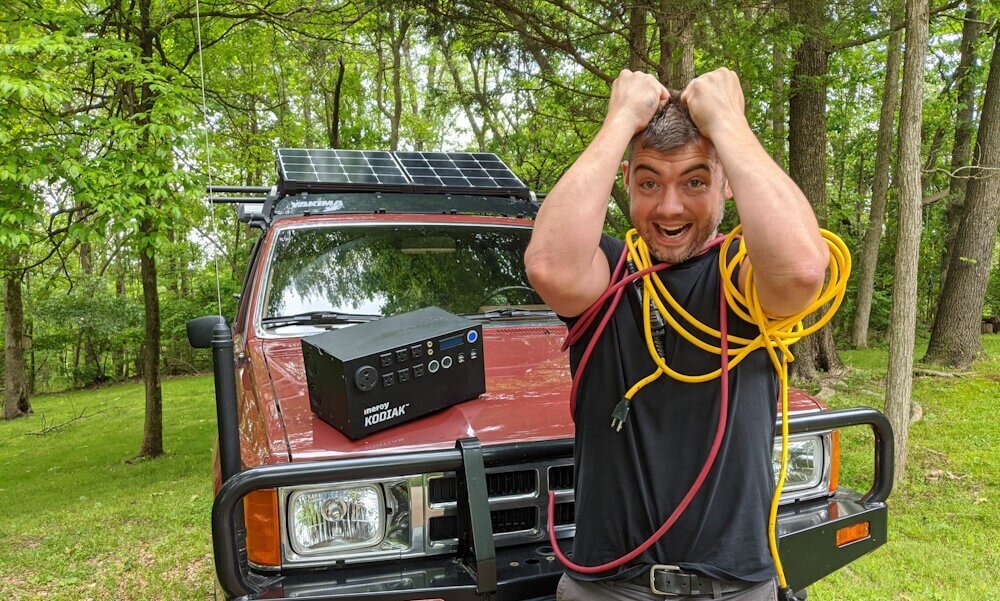
Confused About Electrical Basics

Whelp, I installed a (Victron knock-off) Fusion Energy TBD-SmartShunt bluetooth battery monitor (link) in our 560 yesterday. About half the price of the Victron. I’m thrifty…

It is doing fine, giving good state of charge % info as well as current amp-hours in and out, and estimated time to a user-entered SoC minimum based on current load.

It would have been a straightforward install except my battery compartment is fulla’ other stuff I installed, and it starts off pretty tight from CI. There is NO MORE room in there, and I have to stop doing these electrical add-ons!
full

full
Yeah I was a little surprised when I tried to cram my new battery and shunt into the battery compartment to see how dang tight the fit was. Part of it was the nuclear power plant size power cable the shunt came with. But even without any extra stuff in my battery compartment, it was a really tight squeeze
 
Yeah I was a little surprised when I tried to cram my new battery and shunt into the battery compartment to see how dang tight the fit was. Part of it was the nuclear power plant size power cable the shunt came with. But even without any extra stuff in my battery compartment, it was a really tight squeeze
Right, there is a scale problem with a lot of these upgrades. The shunt monitor will handle at least 5x the power our little electric systems deal in… and lots of the other rv/marine components are designed for larger vehicles than our little trailers.

Victron, dirty6? How is it working for you?
 
Victron, dirty6? How is it working for you?

Sorry, I missed this.

I think there is a learning curve and I think I’m behind it. The Victron needs to be programmed based on the battery system it is attached to. I plugged the appropriate numbers into the app, but I worry that it still hasn’t “learned” the right calibration for the battery yet since the battery shore charger isn’t the proper one for charging the lithium battery.

I also had a deep discharge from a few weeks of parasitic draw when I forgot to flip off the DC disconnect switch. Or maybe the battery protection system just turned itself off? The Victron gave really weird numbers when I got the battery back on a charger to wake it up.

Bottom line, it’s working. …. I just don’t know if it’s working right!
 
For the SmartShunt, it’s important to ensure that all the power flowing in and out of the battery goes through it, including all your loads and chargers. If your current setup only connects the negative cable to the chassis, you may need to change some wiring. This can be a bit complicated, especially if you are not familiar with electrical work. Getting it wrong could cause problems with your system. It’s a good idea to get professional help from companies like powerline contractor Ottawa to make sure everything is connected safely and correctly.
 
For the SmartShunt, it’s important to ensure that all the power flowing in and out of the battery goes through it, including all your loads and chargers. If your current setup only connects the negative cable to the chassis, you may need to change some wiring. This can be a bit complicated, especially if you are not familiar with electrical work. Getting it wrong could cause problems with your system. It’s a good idea to get professional help from companies like powerline contractor Ottawa to make sure everything is connected safely and correctly.
@Jojjymozz this post is a mix of truths and errors. This conversation is about installation of a monitoring shunt in a travel trailer, not a car or truck. A company like the recommended Canadian high voltage powerline contractor would be of little help to any camping trailer owner, much less one in Missouri USA.

On the other hand, it’s certainly true that all loads and chargers must connect on the “to system “ side of the shunt.
 
I found this today, and it was relevant to this discussion. volts=amps * resistance and W=Volts * Amps, but one of my foibles is that when I am put under pressure, I tend to doubt myself terribly and have to double check myself. I am looking for a good visual representation of these laws so I can vinyl cut them, and put them on my clipboard so they are always there....and I found site.

I hope this is helpful --- the visual representation is well done, though, not 100% correct. But certainly close enough without getting into fluid dynamics


View media item 2730
That’s a great resource! Thanks for sharing it.
Perhaps my T-shirt can help with the understanding.
View attachment 11230
Your little guys seem angry :(
They remind me of the shmoo of yesteryear…

Great t-shirt!
 
After damaging and then replacing our original 560 battery with a poor substitute, we have damaged that battery as well and I've thrown up my hands and elected to upgrade the whole system to a lithium battery.

In consultation with Cary, I successfully took delivery of the same lithium battery CI is now installing with new camper builds. However, since I'm upgrading my system, I have a handful of other steps I have to navigate in order to do this. First, I'll have to swap out my CTEK (I have an older version that won't play nice with lithium) in order to have DC-DC charing from the tow vehicle. Second, I'll have to eventually install a new AC charger/tender. Finally, and this is the root of my question today, I will have to install a battery monitor since my trailer does not have the TriMetric.

I'm an admitted novice at any conversation of anything electrical, so please bear with me. I've consulted with some sales reps/dealers, and I have come to think that the Victron SmartShunt 500a battery monitor is a good solution for what I'm doing. The reasoning: most battery monitors include some sort of LCD screen that has to be mounted inside the trailer. As we all know, real estate is a little tight in the battery compartment and trailer. This SmartShunt actually doesn't have a screen at all - it has integrated bluetooth and relies on the user to "provide the screen" by way of a smart phone connection*. Therefore, the shunt can be installed inside the battery cavity and out of sight, and doesn't need any further bulkhead real estate for mounting a display.

I've reviewed the SmartShunt manual and also perused some YouTube educational videos trying to get a feel for how to handle the install. It honestly seems pretty simple and straight forward, but there is one big hangup that I'm sensing.

The install instructions first calls for the battery's negative terminal to be disconnected. The negative cable that had been on the battery now connects to the SmartShunt "System Load Minus" post. This represents all loads (accessories) and chargers. Then, a new battery cable is routed from the SmartShunt "Battery Minus" post to the negative post of the battery. By placing these two cables in this way, essentially all power that goes in or out of the battery flows "through" the shunt and allows it to measure/monitor things. A final simple connection from the SmartShunt to the positive terminal of the battery provides the monitor with the power it needs to work.

Here's what is confusing the snot out of me. When I consult the CI manual, the schematic for the battery/power wiring seems to suggest that the negative cable attached to my camper right now doesn't do anything but connect directly to the chassis ground stud. I don't see where any "loads and chargers" are integrated into that negative battery cable in the camper.

Am I reading this schematic wrong? My novice take-away is that the camper might actually be wired in a way that is incompatible with the product I'm looking at. Near far as I can tell, all of the "loads and chargers" are only connecting to the battery positive post. Is there a basic electrical concept I'm missing here?


*Of course, there is risk here just as with any product that relies on an app or software solution to run - the moment Victron decides to axe their app or stop supporting this model of battery monitor, the app won't work anymore and I could potentially have functioning battery monitor with no way to actually read the data. It would be a battery monitor that I cannot monitor, if that makes sense. I'm keen to that risk because I've recently witnessed the bad version of it from some friends who used the Kamado Joe temperature controller called iKamand. The device can only be controlled by a smartphone, which was great until Kamado Joe decided to stop producing and stop supporting the device. Overnight, folks who had spent 300 bucks on a temperature controller for their grill had nothing but a fancy brick that wouldn't even turn on.

I have the smart shunt and it works fine. There are also li batteries with Bluetooth built in so additional items needed. In youre in cold country I'd recommend one with built in heater mat or at the least a temperature circuit that will stop it from trying to charge when too hot or too cold.
When you get the battery immediately get a new charger specifically for li. They dont charge the same as lead or agi. I put a dc to dc charger by victron in my van and you can also set the parameters for li. Batteries there.in the app. The nice thing about the victron is it can output 40amps for charging instead of 7 to 12 without .it also protects the starter battery from getting too low.
 
Back
Top